Ultras and Professional Football
Hägele, W.: The Ultras and Professional Football in Germany. In: International Journal of Sports and Physical Education, Volume 12, Issue 1, 2026, PP 31-43.
doi.org/10.20431/2454-6380.1201005
< original: page 31 >
Abstract
Since the turn of the millennium, Ultras have come to dominate the fan scene in German football. They attracted public and media attention through their support and spectacular choreographies. Their criticism focused in particular on the ongoing commercialisation and mediatization of modern professional football. This critique was grounded in the socially critical manifesto of the Italian ultras of the 1970s. They lent weight to their critique through protest actions coordinated across Germany. In the initial years, the relationship between the innovative and open youth movement of the ultras and the more conservative professional clubs was marked by deep dissonance. Only in the very recent past has there been a noticeable increase in the willingness to engage in dialogue and co-operation. Yet the more powerful the ultras became, the greater the uncertainty and helplessness of many professional clubs in dealing with them. Ultras by now play an important role in club elections, increasingly assume functions within club leadership, and strongly advocate retaining the 50+1 rule in order to limit the influence of financially powerful investors. They have already achieved initial successes in exploring ways of reducing the dependence of professional clubs on major investors while at the same time strengthening the role of club members and supporters. Finally, the future of the ultra movement and of professional football is discussed. Decisive for the continued existence of the ultras will be whether, and to what extent, they succeed in containing violence, pyrotechnics, and other transgressive actions as persistent sources of conflict.
Keywords
Fans, ultras, support, choreographies, professional football, commercialisation, 50+1 rule, investors
1. Introduction
The ultras have, since the 1990s, created a new type of fan in German football stadiums through their support and their attention-grabbing choreographies. Of greater significance, however, is likely to be their ideological rootedness in the rebellious-revolutionary manifestos of the Italian ultras of the 1970s. It is here that their critique of the advancing commercialisation and mediatization of professional football, and of the resulting consequences for the German club landscape, is grounded.
The main body of this article addresses, in socio-historical terms, the conflict-ridden relationship between the critical-oppositional ultra youth movement and market-oriented professional football from the turn of the millennium into the 2020s. It considers both the growing influence of financially powerful investors in professional football and the attempts to limit this influence. Closely connected with this is the ultras’ critique of the impending loss of traditional, community-oriented football culture. Not least, the article raises the question of who professional football belongs to under conditions of advancing economisation: patrons, sponsors, and investors, or club members, spectators, and fans.
Finally, on the basis of the preceding argument, the future of the ultra movement and of professional football is discussed. At present, the future role of the ultras within the club and in the stadium remains entirely open. Of central importance for sport in Germany as a whole will be whether, and to what extent, the current club-democratic structure of professional football can be preserved, or whether the trend towards the complete market-capitalisation of professional clubs will continue unabated.
< original: page 32 >
2. The Ultras
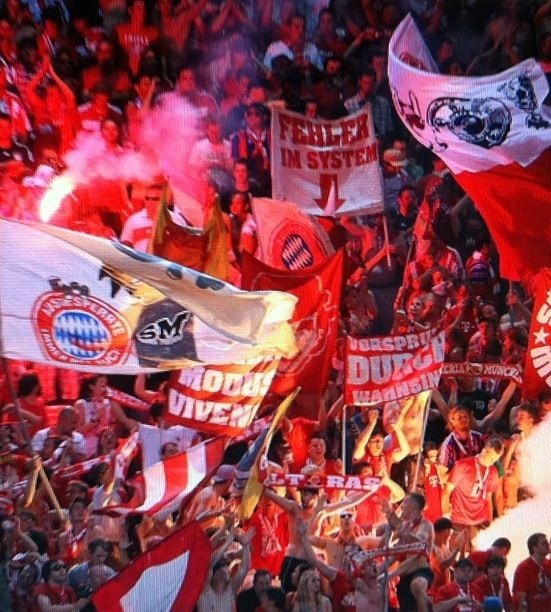
Since the 1990s, the ultras have gained significance and influence in German football stadiums. Located in the standing areas of the stadium terraces, they now not only dominate the fan scene[1], but have also, with their spectacular displays and the unconditional support of their team, created a type of fan previously unknown in Germany (cf. Schwier, 2009, pp. 149 ff.; Kathöfer and Kotthaus, 2013, pp. 268 ff.).
The many banners, waving flags and two-pole banners, which created an unusually colourful and varied scene, took some getting used to. Above all, it was the capo, standing with his back to the pitch, that caused astonishment. With great skill and temperament, he coordinated – in direct rivalry with the opposing fans – the rhythmic clapping, jumping, singing and loud cheering of his ultras (cf. Thalheim, 2019a, pp. 49 ff.). This contributed to the extroverted, exuberant and wild atmosphere that attracted especially adolescents and young adults, who became the driving force of the new fan movement (cf. Pilz, 2012, p. 226).
It was above all the spectacular choreographies that attracted great attention, prepared over weeks of painstaking work under the guidance of particularly active, experienced and highly committed ultras, and requiring considerable time and expense (Pilz and Wölki, 2006, pp. 84 f.). However much the various ultra groups and their members differed from one another in terms of attitude, commitment and participation (cf. Göldner, Kathöfer and Kotthaus, 2013, pp. 172 ff.), the creative and original choreographies and support performances repeatedly compelled them to draw closer to one another and present themselves as a unified group.
With the implicit claim to be the only “true fans” (Pilz and Wölki, 2006, p. 72), they turned the stadium curve into a site of active, collectively shared football experience and thereby distinguished themselves clearly from conventional spectators as well as from the remaining fan groups. The unconditional support of their own team, however, did not prevent many ultra groups from adopting a critical stance towards their club, its players and its officials (cf. Schwier, 2005, pp. 22, 24). They did not base their self-understanding on a silent and uncritical acceptance of developments within the club and in modern professional football more generally (cf. Adam, 2016, pp. 71 ff.). Rather, much to the annoyance and even incomprehension of many club and association officials, they advanced an often rebelliously uncompromising critique, at times accompanied by anarchic-nihilistic protest actions, which on the one hand provoked puzzlement and astonishment and on the other incomprehension and rejection in the public sphere as well as within academia.
3. From Traditional to Modern (Professional) Football
In the 1950s and 1960s, the value system prescribed by the German Sports Association (DSB) as the umbrella organisation – with amateurism, charitable status, honorary office, and grassroots democracy – also formed the constitutive basis of legitimacy for football clubs. In the decades that followed, football became increasingly differentiated into traditional amateur football and modern professional football. The processes primarily responsible for this development were the advancing processes of professionalisation, mediatization, and commercialisation. Intensified by their mutual interpenetration, they ensured that professional football moved ever further away over the years from its traditional centre of values and meaning, and the gap between it and amateur football steadily widened.
a) Professionalisation
With the introduction of the Bundesliga (1963), a process of professionalisation in football that was initially restrained and then gathered pace rapidly was legalised (cf. Gabler, 2013, p. 21). As early as the mid-1970s, the upper limit on players’ salaries was abolished. Thereafter, players’ salaries, bonuses, and transfer fees rose inexorably. The professionalisation of players and coaches was followed in the 1980s by the hiring of economically skilled managers to support the honorary club board. At the end of the twentieth century, the professional divisions were finally spun off from the German Football Association (DFB) into the German Football League (DFL). At the same time, the clubs’ professional departments were transformed into capital companies (cf. Brenner, 2009, pp. 41 f.). Within these capital companies, the 50+1 rule ensured that the parent club retained a majority of voting rights and thus decision-making power, while the power and influence of external investors
< original: page 33 >
remained limited. To what extent this protective clause in favour of the clubs will endure in the future remains entirely open in view of the immense sums that a top club must raise in order to remain competitive in Europe’s leading leagues (cf. Hägele, 2023, p. 44).
b) Mediatization
The great popularity of football among the German population was fostered by sports reporting in which, over the decades, the printed word was gradually pushed into the background by the growing omnipresence of television, the internet, and social media (cf. Nölleke and Blöbaum, 2012, pp. 162 ff.; Gabler, 2013, pp. 84 ff.). The power of television images first became strikingly apparent during the 1954 FIFA World Cup. The Saturday evening Sportschau likewise made a substantial contribution to the growing popularity of the Bundesliga. With the help of satellite broadcasts, it also became possible from the late 1960s onwards to inspire a steadily growing global audience for football through major international tournaments (FIFA World Cups and continental championships).
With the sale of television broadcasting rights, the Bundesliga clubs secured an important source of revenue. Under the leadership of the DFL, and staggered according to league and sporting performance, the clubs received a steadily growing sum of money with which they were able to cover a considerable part of their budgets. By now, television revenues have risen to more than one billion euros per season, and the trend continues upwards. Since the mid-1980s, professional football has also profited considerably from the rise of private and pay television, as well as from the hype triggered by the introduction of the Champions League (from 1992 onwards). Football supporters were thus able to draw on a rich football offering that included not only visits to the stadium, but also digital access to matches in the top European and South American leagues. The price that professional football had to pay for the mediatization of its world consisted in concessions over broadcasting arrangements and a generally greater virtual-digital influence on the actual course of play.
c) Commercialisation
The more attractive professional football in Germany became to the mass media, and the more frequently football matches were broadcast on television in prime time, the more interesting it became for business as an advertising medium (cf. Gabler, 2013, pp. 83 ff.; Brenner, 2009, pp. 42 ff.; Müller, 2017, pp. 98 ff.). In the 1950s, the revenues of the non-profit clubs were still largely confined to membership fees and ticket sales. With shirt sponsorship (1973) at the beginning of professionalisation, a spiral of marketing was set in motion that found its continuation in pitch-side advertising and in the sale of stadium naming rights. By now, leading business enterprises are prepared to spend millions on advertising contracts with professional clubs. Other companies hope to profit as investors by purchasing shares in clubs.
Far from meeting non-profit expectations, professional clubs, in their search for ever new sources of revenue, have developed into market-oriented service enterprises. In contradiction to its traditional values, top-level football became a commodity subject to the principles of profit maximisation. Only through continuing success (victories) – preferably in Europe’s leading leagues – can a professional club secure its market value in the long term. It is no longer the fans in the stadiums who bring in the big money today, but lucrative advertising contracts and financially powerful investors, who are kept satisfied with expensive business and VIP boxes. While the gap between poor and rich professional clubs was already deepened by the league-table-based distribution of television money, it has now become almost unbridgeable through the market-dependent funds provided by business. The continued presence of a top club in the league now seems to depend less on skill and luck than on the money available to a club for its professional division.
4. Ultra Protest Actions against Developments in Modern Professional Football
Many ultras see the excessive influence of the mass media and of business as the central problem of professional football in recent decades. In their view, the hunt for success and thus also for money has led to an alienation of the club from its members and fans. With their arguments, they hark back to the spirit of the 1950s and 1960s and thereby vehemently oppose what they see as the disproportionate media and commercial instrumentalisation of the values and aims of a football culture ultimately grounded in free and informal play (cf. Czoch, 2012, pp. 69 ff.; Gabriel and Goll, 2012, pp. 260 f.).
The protests against the mediatization of professional football were directed in the first instance against the fragmentation of matchdays and kick-off times (cf. Gabler, 2013, pp. 97 f.). In this, the
< original: page 34 >
ultras saw a considerable disadvantage for working fans travelling to away matches on weekdays and in the evenings. To the growing eventisation and media marketability of professional football they opposed the negative example of the Super Bowl, where the half-time show and the time-outs for exorbitantly expensive advertising slots have become almost more important than the game itself. The accompanying media criticism may be one reason why the negative image of the ultras in the press and on television as violence-prone troublemakers throwing pyrotechnic flares was sustained for years (cf. Sommerey, 2010, p. 70), without sufficiently acknowledging the positive aspects of, and the further development of, the ultra movement in recent years.
Through their protest actions against rising ticket prices and against the repeatedly discussed conversion of standing areas in the stadium curves into seating, the ultras even feared for the continued existence of their fan group within the stadium. They also saw a considerable loss of club identity in the steadily growing influence of sponsors and investors. For this reason, they not only tried to boycott their promotional activities on matchdays, but also became more vocal and more aggressive towards their most prominent representatives: Red Bull (RB Leipzig) and Dietmar Hopp (TSV Hoffenheim) (Gabler, 2013, pp. 108 ff.).
By now, the clubs and the DFB are increasingly seeking dialogue with the ultras. The investor deal pursued by the DFL, and thwarted by the ultras through weeks of throwing objects onto the pitch during almost all Bundesliga matches, nevertheless showed the extent to which the struggle over the future of professional football has now assumed conflict-ridden, and at times borderline, forms. With the threatened abolition of the 50+1 rule, many ultras see the total commercialisation of professional football in Germany, and thus the sell-out of club tradition, drawing alarmingly closer. By contrast, Martin Kind (Hannover 96) and Uli Hoeneß/Kalle Rummenigge (FC Bayern), as their most prominent adversaries, hope that this rule change will bring far more lucrative sponsorship and investment contracts and thus enhanced competitiveness in international football business.
The ultras lent weight to their protests by means of banners, two-pole banners, and chants, extending even to suspending support and, as a last resort, staying away from matches. Their actions achieved a strong impact above all through the groups’ supra-regional networking, which made rapid, co-ordinated action possible. Added to this was a high media presence – initially in fanzines, later on the internet and generally on social media. Schwier (2009, p. 157) therefore rightly speaks of a “new variant of fandom”, based on the technological achievements of the media age. Despite all the disagreements, the ultras succeeded already in the 1990s in organising themselves across groups and locations with “Pro Fans” (formerly “Pro 15:30”) and the “Alliance of Active Football Fans” (BAFF). From the outset, these associations participated in the ultras’ demonstrations and protest actions and lent their demands increased emphasis and effectiveness.
5. Critical Potential and the Socio-Cultural Prehistory of the Ultra Movement in Germany
Those seeking explanations for the protesting, critically rebellious side of the ultras will find them in the origins of the ultra movement in Italy (cf. Louis, 2023, pp. 26 ff.; Pilz and Wölki, 2006, pp. 162 ff.). There, from the late 1960s onwards, the first ultra groups emerged in the curva under the influence of Marxist-revolutionary student and workers’ groups and of their fundamental critique of state and society. The close rootedness of the Italian ultras in emancipatory, left-wing social critique remained, despite all the qualitative changes and contrary tendencies that the ultra movement has undergone across countries over the decades, a central element of their self-understanding.
To this day, the manifesto of the AS Roma ultras (1999) is a fixed point of reference for many critical ultra groups.[2] There the essential rules of conduct of the ultras are set down – with strong contemporary relevance:
Ultras should in particular: 1. Refuse every unnecessary contact with or assistance from clubs or the police. 2. Co-operate better among themselves. 3. Work together with the ultras of other clubs in order to make television football less attractive as a commodity. 4. Not allow themselves to be oppressed by authorities.
< original: page 35 >
Without difficulty, one can recognise in these statements the class-struggle orientation of Italy’s rebellious youth against the social establishment in the late 1960s and early 1970s. A critical distance was to be maintained from the traditional institutions of club and society. The spreading commercialisation of society and of modern professional football, they argued, could not be combated by passive indifference, but only through active and resolute action. Above all, in the curva as in the street, the values of solidarity and communal spirit were to stand above all internal disputes and external conflicts.
Because German football traditionally oriented itself towards the English model, the ultra movement in Germany did not gain a foothold until the 1990s. Influenced by the English fan scene, it was initially the Kuttenfans who conquered the German stadiums in the 1970s and 1980s (cf. Pilz, 2006, pp. 53 f.; Langer, 2010, pp. 26 ff.). They expressed their strong attachment to their club and their team through countless patches on their denim jackets (Kutten), as well as through their caps, scarves, and flags in the club colours. In this way, the postmodern aestheticisation of the lifeworld of hippies, rock stars, and (alternative life-)artists of that period found expression in the colourful outfit of the Kuttenfans, clearly distinguishing them from the remaining stadium spectators. At the centre of their thinking, acting, and feeling were the match on the pitch and the passionate support of their own team through chants, songs, and rhythmic clapping. Choreographic displays, by contrast, were only introduced by the ultras. The Kuttenfans consisted almost exclusively of men, who organised themselves in fan clubs or informal cliques. Even in times of continuing failure and relegation to the second division, they mostly remained loyal to their club throughout their lives.
In the 1980s, the Kuttenfans lost their dominance in the football stadiums to the hooligans (cf. Wensierski and Puchert, 2020, pp. 257 ff.; Gabler, 2013, pp. 25 f.). The latter had already acquired dubious notoriety in England through their pronounced readiness for aggression and violence. Often more important to them than the contest on the pitch was the struggle with opposing fans, the police, or the Kuttenfans, which was elevated into an end in itself. Most of the time, the means they used remained limited in that weapons, knives, and deadly violence were excluded. In stark contrast to the Kuttenfans, however, their outfit tended to be inconspicuous. What was striking, though, were the many scarves and hoods intended to make facial identification by the police more difficult. After repeated violent clashes in and around the stadiums, repressive measures against them were intensified (violent-offender databases, stadium bans, surveillance cameras). They then shifted their fights from the stadium to the access routes and into the city centres. Later, once they had lost their power and influence in the stadium and in the curve to the ultras, they preferred so-called “forest-and-meadow matches” (Gabler, 2013, p. 26) in areas beyond the reach of the police and away from the stadiums.
One of the triggers for the turn away from the violence-oriented English fan culture towards the folkloristic Italian fan culture in the 1980s were the disasters in the football stadiums of Brussels and Sheffield, which claimed 135 lives. These events shocked the public and led to intensified police measures against hooligan violence across Europe (cf. Sommerey, 2010, pp. 45 ff.; Brenner, 2009, p. 55). The Italian ultra scene gained growing visibility in Germany above all through the television presence of leading Italian clubs in the Champions League, as well as through German supporters and groundhoppers who were able to experience the world of the ultras at close range in Italian stadiums (cf. Montague, 2023, pp. 254 f.; Gabler, 2013, pp. 54 f.). This led in the 1990s to the rapid spread of the ultra scene in Germany, which reached its peak around the turn of the millennium when the ultras took over the stadium curves – at the expense of the Kuttenfans, who were pushed into the second rank, as well as the right-wing extremist hooligans who remained at least latently present in many stadiums.
6 Postmodern Ultras and Modern Professional Clubs around the Turn of the Millennium and Their Relationship in the Mid-2020s
a) The Ultras at the Turn of the Millennium
The ultras consisted predominantly of young fans who grew up during the first decades of the epochal transition from traditional industrial society (First Modernity) to postmodern information society (Second Modernity), and were therefore directly affected by the multimedia and global transformation of values (cf. Hägele, 2008; 2010). In the hard-won space of freedom and protection of the curve, young fans were able to realise forms of life and expression that had already emerged in the
< original: page 36 >
alternative scene and niche milieu of trend, outdoor, and nature sports in the 1970s and 1980s and that now, with a delay of twenty years, entered the football stadium. Set apart from the adult world, they could live out here a postmodern attitude to life that was often denied them in the tradition-bound everyday life of school, training, and family.
Without constraint, they could join the post-traditional communities of the ultra scene, which were based predominantly on voluntariness, grassroots-democratic principles, and informal structures and offered manifold possibilities for social attachment, commitment, and the assumption of responsibility within the group, but also for an unproblematic withdrawal into the world of conventional spectators. For the postmodern revaluation of individuality and self-determination, they found in the curve an ideal field of exploration, trial, and experimentation which, far removed from institutionalised agencies of socialisation, they could use in innovative ways for the formation of their personalities (cf. Müller, 2017, pp. 167 ff.; Kathöfer, Kotthaus and Willmann, 2013, pp. 48 f.).
However, faced with the inexorable rise of the digital world of signs and images at the expense of the real football match, the ultras feared for their continued indispensability in the hyperreal world of mass media and condemned this development – much like Baudrillard (1978, pp. 7 ff.; 1982, pp. 90 ff.) – as a disastrous prospect for the future.
At the same time, however, they owed their steep rise in the curve to the internet as a welcome stage for their self-presentations, as well as to a dense network of digital contacts and forums that enabled a rapid intrasystemic exchange of information.
For many young fans, the main attraction of the curve lay in being able to give free rein to their feelings amid supports and choreographies and among a throng of loud, cheerfully exuberant like-minded fans. The negative side of this sensuous re-enchantment of the football stadium, however, revealed itself in the transgressive obscenities, racist insults, and violent confrontations (cf. Behn and Schwenzer, 2006, pp. 320 ff.), which all too often clouded the image of the harmless amusements of the curve fans and increasingly attracted criticism across society.
Viewed from a critical distance, the aesthetically romantic side of the ultras ran counter to their emancipatory-progressive manifesto principles. Although the socially revolutionary ambitions of alternative outdoor, fitness, and experience sports of the 1970s ebbed away after only a short time, they nevertheless found a remarkable revival – albeit in greatly weakened form – in the ultras’ critique of the commodity character of modern professional football in Germany.
b) The Professional Football Clubs at the Turn of the Millennium
In contrast to the postmodern world of the ultras, professional football clubs showed a strong tendency to cling to established structures. For the most part, they remained attached to the traditional values of industrial modernity. Accordingly, values such as performance and success, discipline and order, as well as hierarchy and obedience, ranked highly. The normative obligations of a collectivist-altruistically oriented individuality, as Parsons (1968; 1986) advocated in his social theory, were mostly rated more highly than reflexive role behaviour.
Much like business enterprises, professional football clubs were fully occupied with exploiting the continuing upswing in the football business to their own advantage. Economic thinking according to the laws of supply and demand increasingly displaced the amateur ideology that had prevailed for decades. As a result of the unchecked quantitative growth of the professional clubs, a qualitatively demanding questioning of the path taken gradually faded away. In professional football, money also ceased to be a mere means and became an almost exclusive end of exchange transactions (cf. Simmel, 1983, pp. 78 ff.), thereby favouring an instrumentalised social club structure that impaired the social cement of the original sense of community invoked by the ultras.
The relationship between the professional clubs and the ultras was initially marked by profound dissonance. What predominated was a lack of understanding of the defiant and often unruly ultra scene in the stadium curves, which was at times confused with the hooligan scene. The ultras’ undisguised criticism of club policy, as well as their many protest actions, were partly responsible for the often distant and frequently prejudiced attitude of the professional clubs towards the ultras. This distance was reinforced by the autonomy demanded in the ultra manifesto, together with the avoidance of unnecessary contacts with the club, which was reflected in the ultras’ separate organisational structures (cf. Czoch, 2012, p. 74). With restrictions, bans, and sanctions that had been
< original: page 37 >
introduced during the height of hooliganism, the clubs tried to tame the ultra scene. Because of the willingness to use violence shown by some ultra groups, as well as the enduring problem of pyrotechnics in the stadium, however, the ultras’ conflicts with clubs, associations, the police, and security forces could never be fully resolved (cf. Müller, 2017, pp. 111 ff.). Through the excessively harsh deployment of police forces, but also through provocative actions by the ultras, these conflicts at times escalated instead. It is therefore hardly surprising that professional clubs considered abolishing the standing areas in the stadium curves, with reference to the rigid repression directed against hooligans in England and recalcitrant ultras in Italy.
Regardless of all the oppositions, a cautious rapprochement between the professional clubs and the ultras took place above all through support and spectacular choreographies. Not only did spectator numbers rise as a result; almost more important was the gain in image, from which the clubs also benefited as the hosts of the stadiums. From this there developed in some clubs a pragmatic co-operation based on reciprocity: on the one hand, the clubs supported the ultras in the production of their displays; on the other hand, they were able to increase their market value through the ultras’ activities (cf. Schwier, 2005, p. 35).
There was also a growing awareness that purely repressive punitive measures, especially in the context of youth subcultures, often tended to aggravate rather than resolve conflicts. There was an urgent need for supplementary socio-educational measures. Fan officers and fan projects committed to dialogue and prevention, for instance, could help to reduce mutual prejudices and the distance between ultras, clubs, associations and the police, and to foster mutual understanding and trust (cf. Pilz, 2012, pp. 236 f.; Müller, 2017, pp. 175 ff.). For years, however, this de-escalation concept found only limited application. Nevertheless, the relationship of individual clubs to the ultras improved noticeably, without the ideological gulf and the ultras’ struggle against the continuing commercialisation of modern professional football generally losing significance.
c) The Ultras and Professional Football Clubs in the Mid-2020s
It remains difficult to make reliable statements about the relationship between ultras and professional clubs in the mid-2020s. The ultra groups are too heterogeneous and differ too greatly in qualitative and quantitative terms, both in terms of their integration into the wider scene and into the clubs. The ultra manifesto, imbued with the revolutionary spirit of the 1970s, has by now lost some of its force and influence, or seems to have been modified in many places: at least the more level-headed ultras have recognised that they will suffer damage in the long run if they, as in the early years, reject (almost) every contact with their club, the police, or the media.
Despite all internal rivalries and differences of opinion, they have learnt to articulate their interests, wishes and concerns in a knowledgeable and well-argued manner within working groups composed of representatives of the clubs, the police and the security forces. Through agreements, for instance within supporter advisory boards, with police officers, club representatives, security personnel, and fan officers, they now help in many clubs to ensure that matchdays, including the arrival and departure of supporters, pass off mostly peacefully and without violent disturbances. In return, the clubs allow them to set up information stands in the stadium area and to sell their own merchandise. In principle, these are non-profit stands, the proceeds of which are intended either to go towards the ultras’ choreographies or to serve charitable purposes (cf. Thalheim, 2019b, pp. 108 ff.). Cases of abuse, such as in Italy, accompanied by substantial personal enrichment, are currently not known in Germany (cf. Louis, 2023, pp. 329 ff.).
Opponents of this development object that, with the sale of their own products, the ultras’ critique of the advancing commercialisation of professional football would lose a considerable amount of credibility. The closer the contact between ultras and their home club were to become, moreover – especially when fostered by free tickets, discounted season subscriptions, or jobs within the club (stewarding duties) – the greater, they argue, would be the danger that the ultra movement might become a compliant appendage of the clubs.
At present, this danger does not seem to exist. Through their spectacular supports and choreographic displays, but also through their persistence and remarkable cohesion in their nationwide protest actions, the ultras have by now earned sufficient respect and recognition, not only among spectators and fans, but in part also among club officials. The remaining spectators do not always approve of the
< original: page 38 >
ultras’ actions. They often feel disturbed by the many flags and the deafening noise in the stadium. Nor is the elitist arrogance of certain ultras always well received. Yet the spectators in the main stand for the most part showed solidarity and supported the ultras in their stadium-wide actions as best they could.
The critical ultras’ determination to intervene and to exert influence on club policy has in recent years led them to take the initiative ever more strongly on matchdays and to voice approval or criticism of their team’s success or failure. Driven by the often heated and emotionally charged atmosphere during and after a match, repeated transgressive actions by disinhibited ultras and fans have occurred. Suffice it to mention the shocking hunting scenes on Schalke 04, when, following relegation to the second Bundesliga in 2021, the professionals and those responsible could only escape violent fans by fleeing. How powerful the ultras have meanwhile become in many clubs was also demonstrated by the televised dressing-down by an ultra leader on the pitch after SV Darmstadt 98’s 0–6 defeat to FC Augsburg in March 2024. Not only did the players, together with the coach, stoically endure the dressing-down for several minutes; at the end of the address, they even applauded the wildly gesticulating capo.
The subsequently conciliatory words of the Darmstadt club management are symptomatic of the current helplessness and perplexity of many professional clubs. Apparently out of fear of unrest and of the negative public perception associated with it, they seek as far as possible to avoid open confrontation with the powerful ultras – even in cases of inexcusable transgressions. Added to this is the fact that ultras who have joined the club now play an increasingly weighty role in club elections. Club officials who wish to be re-elected shy away from turning the ultras against them. Perhaps they really have become too powerful, as the current state of paralysis among club officials suggests. The positive side of this development, however, is that top officials, often detached from the club base, can no longer simply govern in patriarchal fashion, but are subject in their decisions to an unfamiliar degree of scrutiny by the ultras. Of necessity, they must pay greater heed to the interests of the fans than was the case in the past.
The overall balance of the ultras’ influence in Germany on club and association policy in professional top-level football nevertheless remains ambivalent. Their protests attracted public attention, but often led to little more than a partial reversal of decisions made by clubs, associations, or the government. The ultras’ struggle against the continuing commercialisation of modern professional football also appears to have met with little success. The euphoria of growth in the football business continues unabated. It is becoming ever clearer that, in future, a manageable number of top clubs will dominate European football. Their successes rest increasingly on the billions of financially powerful investors whose foremost interest is to generate profit, prestige, and influence. To secure their power and influence, top clubs like Manchester United have begun to cultivate relationships with smaller clubs—even across national borders—as sources of talent.[3] The introduction of a European Super League made up of only a few major clubs has so far been prevented. Yet a self-contained league with an open championship and in which relegation for clubs is largely ruled out would certainly be the ideal solution for risk-averse investors, making the business of football even more lucrative. It therefore remains to be seen when the next step in this direction will be taken, especially since Europe’s top officials hope to share in this billion-euro game.
In Germany, the 50+1 rule discourages many financially powerful investors, especially foreign ones. Their influence within the club is limited by the majority voting rights of the parent club and its members. Insofar as, however, in professional football more money also promises more success, the 50+1 rule gives rise to a competitive disadvantage for the leading German clubs in relation to their competitors from England, Spain, Italy, and France, who are not subject to this arrangement. For this reason, the abolition of this rule has repeatedly been called for—chiefly from the ranks of (former) players, coaches, and officials—though so far without success, as it is deeply embedded in the DNA of German club structures.
The 50+1-rule was upheld above all by the ultras, who repeatedly asserted that football belongs to the fans rather than to investors. They are fully aware of the disadvantages that arise for top-level German football from the clubs’ majority ownership. Nor do they deny that leading German clubs depend on the financial support of Audi, Allianz, and similar companies in
< original: page 39 >
order not to be left hopelessly behind in the European leagues. Nevertheless, critical ultras and a small number of innovative professional clubs have begun to search for alternative paths by which the fatalistic dependence on external capital might be reduced, the club base strengthened, and competitiveness in European league football preserved at the same time.
Pioneers of greater openness towards fans were clubs such as FC St. Pauli and Union Berlin, which did not from the outset dismiss the initiatives of the ultras as improper interference in the affairs of the club, but were prepared to incorporate constructive proposals into their decision-making processes. Reform efforts drew attention, seeking, through the spin-off of clubs’ professional departments into partnerships limited by shares (Kommanditgesellschaften auf Aktien[4]), to strengthen the position of club members and weaken the influence of investors. Ultras in turn also helped to found a co-operative, as at FC St. Pauli (2024), which anyone—not only club members—can join and through which they can acquire shares in projects that benefit the club.
Most attention, however, was attracted by the Berlin Path, initiated with overwhelming support from the fans by the late Hertha BSC president and former ultra capo Kay Bernstein, who died in January 2024.[5] Alongside reducing the club’s high level of debt, the stated aims were: the greatest possible independence from investors; the strengthening of co-determination by fans and members; the reduction of the costly player budget through the promotion of young home-grown talent; and the acceptance of the almost inevitable relegation to the second Bundesliga. Critics, especially from the media, remained sceptical observers of the Berlin Path, which, they argued, would founder on the hard realities of the professional game and inevitably lead to second-rate status.
Nonetheless, the examples mentioned have shown that changes to the basic structures of modern professional football are indeed possible. Ultras are by no means merely thrill-seeking problem fans with a penchant for prohibited pyrotechnics and occasional violent actions. In co-operation with committed club representatives, they have succeeded, at least partially, in enriching the debate on the future of professional football with several proposals worthy of discussion – a future that, for critical ultras, should not be measured solely by success and profit.
7. Outlook on the Future of the Ultras and of Modern Professional Football
Statements about the future of the ultras are complicated by the ultra scene’s great heterogeneity, fluctuation, and predominantly informal structure. Added to this is the ultras’ ambivalent relationship to the club. In light of the ultras’ recent demonstrations of power, but also of their partial integration into the decision-making processes of some clubs, their future role in professional football remains largely unclear. Traditionalists view the recent development rather sceptically, whereas reformists see it as an opportunity for innovative structural change. The future, however, can neither be planned nor predicted reliably. Nevertheless, it is worth reflecting on it on the basis of the developmental trajectories outlined in both the fan/ultra scene and professional football:
a) The present dominance of the ultras in the fan scene must not obscure the fact that their future will depend decisively on the extent to which their more level-headed elements succeed in bringing life-threatening violence, degrading forms of discrimination, and anarchic pyrotechnic activities under control as enduring sources of conflict. The apparent helplessness and lack of guidance on the part of the clubs in the face of such violations – such as the dehumanising protest action depicting Dietmar Hopp in the crosshairs (2020) or the throwing of objects onto the pitch in protest against impending investor influence (2024), which ultimately damaged the structural core of the game – can quickly turn into its opposite and, should injuries and deaths occur in a further escalation of the conflict, lead to the destruction of the ultra movement through concerted action by the state, the association, the clubs, and the police.
The self-reflection initiated by critical ultras, involving the dismantling of enemy images, a greater willingness to engage in dialogue externally, and more restrained conduct internally, may meet with fierce resistance from many freedom-loving young rebels, chaotic spirits, and revolutionaries among
< original: page 40 >
the ultras. In the long run, however, the ultra movement will hardly be able to maintain its legitimacy and right to exist within the club and in society without these restraining measures.
b) The future position of the ultras within the club and in relation to it remains entirely unclear. In the past, their desire for greater participation and co-determination within the club was articulated largely from a subcultural outsider position and in rebellious confrontation with the club. In order to counter the accusation of undemocratic interference in the affairs of the club, they will therefore – much like The Greens in politics – have to undertake a march through the institutions of the professional clubs in order to consolidate their position and influence within the club. Only through official membership and the assumption of functions within the club will they be able to lend their demands and wishes greater grassroots-democratic legitimacy.
Alternatively, they may once again retreat – whether voluntarily or involuntarily – into the traditional role of spectators, without any further aspirations to shape club politics. Approaches to integrating the ultras into club structures are now in place. It nevertheless appears rather unlikely that the rather conservative club officials will, across the board, be prepared to break up the status quo in innovative ways while weakening their own position. It is also uncertain whether the fragile unity and cohesion of the ultras would, through a stronger orientation towards the club, be exposed to intolerable strains, up to and including the secession of those unwilling to join because they are interested primarily in support.
Nor should their formerly postulated distance from the club lead to the misguided integration of a club within the club. Greater would seem to be the danger of an assimilation of the progressive subculture of the ultras to the tradition-bound structures of the club carried too far. Just as little should the increasing institutionalisation of the ultra movement lead to the loss of its critical innovative potential. More conducive to the future would seem to be a balanced interplay of co-operation and opposition between club and ultras in the search for the best possible solution for the future of professional football.
c) The postmodern revaluation of the senses, of feeling, and of intuition found expression in professional football especially in public viewing and in the choreographies of the ultras. For young ultras, the football match offered the welcome opportunity to be, for a few hours, part of an experience-oriented community that, through its exhilarating support, itself contributed to that mostly exuberant atmosphere full of cheerfulness, lightness, but also wildness (far removed from the seriousness of life), which is characteristic of the ultra scene.
From the perspective of game theory, however, the tendency towards the instrumentalisation of the football match through support cannot be denied. Choreographic displays in particular often push the football match from the centre of events to the margins. At times, support even tends to detach itself entirely from the course of play.
Also not unproblematic is the mood monopoly claimed by the ultras, which finds expression in an almost endless state of continuous action. As a result, the great majority of spectators outside the curve often find it difficult to follow the game in a self-determined way according to their own preferences. It is paradoxical, moreover, that the eventisation of professional football criticised by the ultras is substantially sustained and advanced by their support and choreographies.
d) The ultras fight for the preservation of traditional football culture and see in the continuing commercialisation of professional football the principal cause of the loss of significance of fans and spectators. It is, however, never entirely clear which tradition is meant. Often an idealised past is invoked, aligned with positive periods in the history of the club and the city, which reflect reality in mythically heightened form.
What is largely overlooked here is the fact that the shift in values associated with the postmodern information society, brought about by mobile phones, the internet and social media, is the main cause of the de-traditionalisation of social relations, whilst the economy is merely an indirect factor. This epochal social upheaval has by now also left clear traces in the sphere of professional football. The growing significance of the digital media spectator alongside – and at the expense of – the analogue stadium-goer will hardly be stoppable, despite the current rush to the stadiums. Rather than committing itself to a backward-looking traditionalism, the more promising strategy for the future seems to be to acknowledge, in principle, the ongoing digitalisation of the analogue football world. The influence of the media on fixture planning, broadcasting times, and professional football more generally will, despite all criticism, not decrease but will rather continue to increase with the further development of artificial intelligence.
< original: page 41 >
Nevertheless, the hyperrealisation of the game at the expense of its natural immediacy, through the still incipient coupling of the real game with a growing flood of digital images and event-oriented background information, must remain subject to critical scrutiny. Despite all visual and media influences, football must not lose its rootedness in the physical, sensuous and social world and succumb to a boundary-dissolving Super Bowl spectacle.
In the digital media age and in the context of climate change, moreover, smaller stadiums with capacities of twenty to thirty thousand spectators represent a future option that is at present scarcely imaginable, but not entirely to be ruled out. The empty or only partially filled stadiums during the coronavirus pandemic nevertheless showed that professional football lacks the necessary atmosphere without stadium spectators to touch the hearts and minds of players and (television) viewers alike.
Alongside classical professional football, new modes of play are also conceivable in the future which, though scarcely tested at present, with their postmodern habitus, stronger participation by the community, and greater variability in the rules of the game, nevertheless arouse great interest among young spectators experienced in streaming and thus emerge as potential competitors and successors to the ultras.[6]
e) At present, the outcome of the ultras’ struggle for the retention of the 50+1 rule remains entirely open. Instead of seeking the abolition of this rule, fan-oriented clubs are attempting to counter the spread of investor capitalism by strengthening the ideal and material participation of their members and fans in club life. Whether the current search for alternative paths under the preservation of the 50+1 rule can give rise to a forward-looking movement is more than doubtful. The framework conditions in European top-level football are too contradictory, and the available capital too nearly unlimited, for the financial disadvantages of the German special path to be permanently offset by better training of players, coaches, or managers.
The power of illegal money had already led to the abolition of the amateur paragraph in Olympic sport in 1981. Since then, the monetisation of (professional) football has advanced inexorably, with no end in sight. The 50+1 rule, introduced in 1998, was a makeshift arrangement designed to prevent the 150-year tradition of non-profit gymnastics and sports clubs in Germany from being completely discredited. Abolishing this rule would mean that investors – as is the case in Spain or England – could gain unrestricted control over professional clubs. Ultimately, the price to be paid for this would be the loss of professional football clubs’ full membership of the German Olympic Sports Confederation (DOSB). Otherwise, new makeshift arrangements would have to be found that could secure their continued membership. If the 50+1 rule were abolished without replacement, professional clubs would no longer be subject to the democratic control of club members, but ultimately to the will and arbitrariness of the respective majority owner. Whether, under such conditions, the idealistic, disinterested canon of sporting values long advocated could still remain a guiding principle in the professional sphere, or whether time-adapted modifications would be unavoidable, would require a fundamental discussion free of prejudice.
Excessively heightened idealistic expectations of professional football are likely to suffer when the call – not least from spectators – for better players and coaches, and thus for even more capital-intensive investment, grows almost compulsively louder as success fails to materialise; driven by the iron law of profit maximisation and success. At present, the hope of moderating the early-modern performance principle, rooted in Coubertin’s faster, higher, stronger, seems impossible to realise, despite the intensifying crisis potential in sport and society. The opposite appears more likely.
Notes
[1] Cf. Hitzler and Niederbacher (2010, pp. 15 ff.) on the concept of scene.
[2] Cf. the manifesto of the Dortmund BVB Ultras (2001).
[3] The cooperation agreement between FC Bayern and SpVgg Unterhaching from 2024 to improve youth development appears to pursue similar objectives.
[4] Cf. the 2024 change in legal form at Hamburger SV from HSV Fußball AG to HSV Fußball AG & Co. KGaA.
[5] On Bernstein and the Berlin Path, cf. the ZDF report of 5 May 2024 and the report on Hertha BSC’s members’ meeting. https://www.herthabsc.com/de/nachrichten/2024/05/nachbericht-mitgliederversammlung-mai-2324 [19.05.2026].
[6] Cf. Gerard Piqué’s Kings League and Toni Kroos’s Icon League.
References
Adam, S. (2016): Die Ultra-Fußballfankultur. Eine Jugendkultur im Spannungsfeld zwischen Vergangenheit und Zukunft. In: Duttler, G./Haigis, B. (eds.): Eine Fankultur im Spannungsfeld unterschiedlicher Subkulturen. Bielefeld, pp. 63–86.
Baudrillard, J. (1978): Agonie des Realen. Berlin.
Baudrillard, J. (1982): Der symbolische Tausch und der Tod. München.
Behn, S./Schwenzer, V. (2006): Rassismus, Fremdenfeindlichkeit und Rechtsextremismus im Zuschauerverhalten und Entwicklung von Gegenstrategien. In: Pilz, G. A./Behn, S./Klose, A./Schwenzer, V./Steffan, W./Wölki, F.: Wandlungen des Zuschauerverhaltens im Profifußball. Schorndorf, pp. 320–435.
Brenner, D. (2009): Neues aus der Fankurve. Wie Ultras und andere Fanszenen die Fankultur verändern. Marburg.
Czoch, P. (2012): Wandel von Fanidentitäten im Zuge kommerzieller Entfremdung. In: Thein, M./Linkelmann, J. (eds.): Ultras im Abseits? Porträt einer verwegenen Fankultur. Göttingen, pp. 68–75.
FC St. Pauli (2024): Gründung der ersten Genossenschaft im Profifußball. https://www.fcstpauli.com/verein/organisation/genossenschaft [23.05.2026].
Gabler, J. (2013): Die Ultras. Fußballfans und Fußballkulturen in Deutschland. Köln.
Gabriel, M./Goll, V. (2012): Die Ultras. Zukunftsperspektiven einer jugendlichen Subkultur. In: Thein, M./Linkelmann, J. (eds.): Ultras im Abseits? Porträt einer verwegenen Fankultur. Göttingen, pp. 256–269.
Göldner, R./Kathöfer, S./Kotthaus, J. (2013): Mannschaftsaufstellung: Über die innere Struktur einer Jugendszene. In: Kathöfer, S./Kotthaus, J. (eds.): Block X – Unter Ultras. Ergebnisse einer Studie über die Lebenswelt Ultra in Westdeutschland. Weinheim, Basel, pp. 170–267.
Hägele, W. (2008): Individualisierung und Körperkultur in nationaler Moderne und globaler Postmoderne. München.
Hägele, W. (2010): Annäherungen an den >post<modernen Sport. München.
Hägele, W. (2023): Die Grenzen des Wachstums und der moderne Hochleistungssport im Spiegel gesellschaftlicher Veränderungen. München.
Hitzler, R./Niederbacher, A. (2010): Leben in Szenen. Formen juveniler Vergemeinschaftung heute. Wiesbaden.
Kathöfer, S./Kotthaus, J. (2013): Abpfiff: Zentrale Ergebnisse und zusammenfassende Diskussion. In: Kathöfer, S./Kotthaus, J. (eds.): Block X – Unter Ultras. Ergebnisse einer Studie über die Lebenswelt Ultra in Westdeutschland. Weinheim, Basel, pp. 268–273.
Kathöfer, S./Kotthaus, J./Willmann, M. (2013): Aufwärmphase: Ein Blick in die Geschichte des Fußballs und seiner Fans. In: Kathöfer, S./Kotthaus, J. (eds.): Block X – Unter Ultras. Ergebnisse einer Studie über die Lebenswelt Ultra in Westdeutschland. Weinheim, Basel, pp. 23–53.
Langer, D. (2010): Faszination Ultras. Aspekte und Erklärungsansätze zur Fußballfan- und Jugendkultur. Bonn.
Louis, S. (2023): Ultras. Geschichte einer Bewegung. Wien.
Manifest der Roma-Ultras (1999). http://www.asromaultras.org/manifesto.html [02.10.2024].
Manifest der Dortmunder BVB-Ultras (2001). https://www.schwatzgelb.de/artikel/2001/unsa-senf/2001-01-29-im-fokus-ultramanifest [19.05.2026].
Montague, J. (2023): Unter Ultras. Eine Reise zu den extremsten Fans der Welt. München.
Müller, M. (2017): Zur Kultur von Ultras im Fußball: Eine jugendbiographische Betrachtung. Berlin.
Nölleke, D./Blöbaum, B. (2012): Medial dabei statt mittendrin? Sportzuschauer als Medienrezipienten. In: Strauß, B. (ed.): Sportzuschauer. Göttingen, pp. 162–179.
Parsons, T. (1968): Sozialstruktur und Persönlichkeit. Frankfurt/Main.
Parsons, T. (1986): Aktor, Situation und normative Muster. Ein Essay zur Theorie sozialen Handelns. Frankfurt/Main.
Pilz, G. A. (2006): Fußball ist unser Leben!? – Zur Soziologie und Sozialgeschichte der Fußballfankultur. In: Brandes, H./Christa, H./Evers, R. (eds.): Hauptsache Fußball. Sozialwissenschaftliche Entwürfe. Gießen, pp. 49–69.
Pilz, G. A. (2012): Zuschauergewalt im Fußball – Vorurteile und Diskriminierung: Hooligans, Ultras und Hooltras. In: Strauß, B. (ed.): Sportzuschauer. Göttingen, pp. 214–239.
Pilz, G. A./Wölki, F. (2006): Ultraszene in Deutschland. In: Pilz, G. A./Behn, S./Klose, A./Schwenzer, V./Steffan, W./Wölki, F.: Wandlungen des Zuschauerverhaltens im Profifußball. Schorndorf, pp. 63–238.
Schwier, J. (2005): Die Welt der Ultras. Eine neue Generation von Fußballfans. In: Sport und Gesellschaft, vol. 2, no. 1, pp. 21–38.
Schwier, J. (2009): Ultras – Zur Selbstmediatisierung jugendlicher Fußballfans. In: Mikos, L./Hoffmann, D./Winter, R. (eds.): Mediennutzung, Identität und Identifikationen. Die Sozialisationsrelevanz der Medien im Selbstfindungsprozess von Jugendlichen. Weinheim, München, pp. 149–162.
Simmel, G. (1983): Das Geld in der modernen Kultur. In: Simmel, G.: Schriften zur Soziologie. Frankfurt/Main, pp. 78–94.
Sommerey, M. (2010): Die Jugendkultur der Ultras. Zur Entstehung einer neuen Generation von Fußballfans. Stuttgart.
Thalheim, V. (2019a): Tribünenpraktiken von Ultrafans im Fußballstadion: Von Zuschauer*innen zu Mitmacher*innen. In: Thole, W./Pfaff, N./Flickinger, H.-G. (eds.): Fußball als Soziales Feld. Studien zu Sozialen Bewegungen, Jugend- und Fankulturen. Wiesbaden, pp. 49–62.
Thalheim, V. (2019b): Heroische Gemeinschaften. Ich-bin-Räume von Ultras im Fußball. Weinheim, Basel.
Wensierski, H.-J. von/Puchert, L. (2020): Die Jugendkulturen der Fußballfans im 20. Jahrhundert. In: Gibson, A./Hummrich, M./Kramer, R.-T. (eds.): Rekonstruktive Jugend(kultur)forschung. Flashback – Flashforward. Wiesbaden, pp. 249–268.